Business Intelligence trends, often abbreviated as BI, refers to the technologies, strategies, and practices organizations use to collect, analyze, and present business data. The main goal? To help companies make smarter, faster decisions based on solid evidence rather than guesswork. Imagine BI as your company’s brain — constantly gathering information, processing it, and helping you navigate the complex world of business with confidence.
Why Business Intelligence Trends is crucial for modern businesses
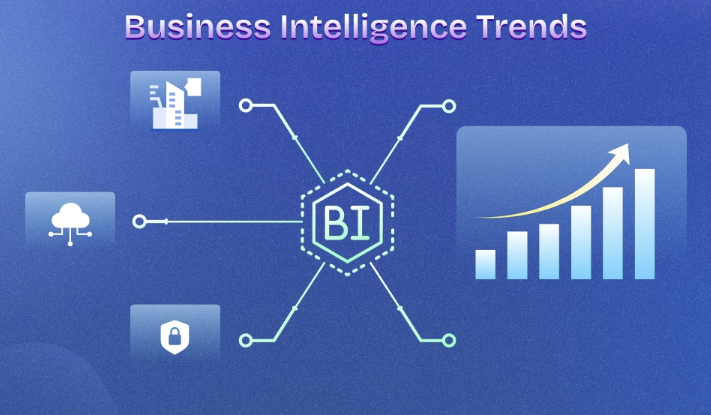
In today’s hyper-competitive market, companies that fail to leverage data risk falling behind. BI is no longer just a luxury for large corporations — it’s a necessity for businesses of all sizes aiming to optimize operations, improve customer experiences, and uncover new revenue opportunities. The year 2025 brings even more advanced BI trends that promise to revolutionize how businesses turn data into value.
The Rise of Augmented Analytics
Defining augmented analytics
Augmented analytics is the next step in the evolution of BI, combining artificial intelligence (AI) and machine learning (ML) to automate data preparation, insight generation, and explanation. Think of it as a supercharged assistant that not only crunches numbers but also tells you what matters most — in plain English.
How AI and ML transform Business Intelligence Trends Insights
AI and ML algorithms sift through vast datasets far quicker than humans, spotting patterns, anomalies, and trends that might otherwise go unnoticed. They can even predict future outcomes, helping businesses anticipate market shifts before they happen. This level of automation frees analysts to focus on strategic interpretation rather than tedious data wrangling.
Impact on decision-making speed and accuracy
With augmented analytics, decisions become faster and more accurate. Instead of waiting days for reports, stakeholders receive real-time, AI-powered recommendations. It’s like having a crystal ball that guides your business choices — reducing risks and boosting competitive advantage.
Increased Adoption of Real-Time Data Processing ( Business Intelligence Trends )
Importance of real-time analytics
In a world where milliseconds matter, real-time data processing is king. Businesses want instant answers — whether it’s monitoring supply chains, tracking customer behavior, or detecting fraud. Real-time BI allows companies to react immediately, not after the fact.
Technologies enabling instant data access
Technologies like streaming data platforms (e.g., Apache Kafka), in-memory databases, and advanced analytics engines enable this instantaneous data flow. These tools allow data to be analyzed as it’s generated, creating a seamless and dynamic intelligence system.
Use cases across industries ( Business Intelligence Trends )
From financial trading floors making split-second decisions to e-commerce platforms personalizing offers on the fly, real-time analytics are becoming a standard. The ability to monitor and act on live data is reshaping industries worldwide.
Democratization of Data Access ( Business Intelligence Trends )
Self-service Business Intelligence Trends tools
Gone are the days when only data scientists could touch analytics software. Self-service BI tools empower anyone in the organization — from marketing to HR — to explore data, create reports, and uncover insights independently.
Empowering non-technical users
These tools feature intuitive drag-and-drop interfaces, natural language queries, and guided analytics, making BI approachable. This democratization encourages a data-driven mindset across teams, breaking down bottlenecks in decision-making.
Overcoming data silos ( Business Intelligence Trends )
Democratized access also helps break down data silos. When everyone can view and analyze relevant data, collaboration improves, and decisions align with a unified, accurate understanding of business reality.
Integration of BI with Cloud Computing
Cloud BI advantages ( Business Intelligence Trends )
Cloud computing offers scalability, cost efficiency, and accessibility. BI platforms hosted on the cloud allow companies to store and analyze huge volumes of data without investing heavily in infrastructure.
Hybrid and multi-cloud strategies ( Business Intelligence Trends )
In 2025, hybrid and multi-cloud BI deployments are gaining traction. Businesses balance public and private clouds to optimize performance, security, and cost, tailoring solutions to their unique needs.
Security and compliance considerations
With data privacy regulations tightening, cloud BI vendors are enhancing security features and compliance certifications. Ensuring data protection while maintaining agility is a top priority.
Natural Language Processing (NLP) in Business Intelligence Trends
Conversational analytics
NLP allows users to interact with BI systems using everyday language — whether by typing questions or speaking aloud. Imagine asking your dashboard, “What were our top sales last quarter?” and getting instant answers.
Making BI accessible via voice and text
This technology removes technical barriers and speeds up insight discovery. Users don’t need to master complex query languages; they simply converse with the system.
Enhancing user experience ( Business Intelligence Trends )
NLP-powered BI tools deliver a smoother, more intuitive experience, which drives broader adoption and more consistent use across organizations.
Predictive and Prescriptive Analytics
Going beyond descriptive analytics
Traditional BI mostly describes what happened. Predictive analytics forecasts what’s likely to happen next, while prescriptive analytics suggests actions to optimize outcomes.
Forecasting trends with predictive models
By analyzing historical data and external factors, predictive models estimate sales, customer churn, inventory needs, and more, helping businesses prepare for the future.
Optimizing actions with prescriptive analytics
Prescriptive analytics doesn’t stop at prediction. It recommends specific strategies — such as adjusting prices or reallocating resources — based on predicted scenarios, creating a proactive approach to business challenges.
Focus on Data Governance and Ethics ( Business Intelligence Trends )
Growing importance of data privacy
With data breaches and privacy concerns escalating, strict data governance policies are vital. Companies must ensure data quality, transparency, and user consent.
Ethical AI and BI practices ( Business Intelligence Trends )
As AI becomes deeply embedded in BI, ethical considerations emerge — avoiding biases, ensuring fairness, and maintaining accountability in automated decisions.
Compliance with global regulations
Legislation such as GDPR, CCPA, and others requires businesses to implement rigorous compliance frameworks. Data governance helps prevent costly legal repercussions.
BI in Edge Computing Environments ( Business Intelligence Trends )
What is edge computing?
Edge computing processes data closer to the source (like IoT devices) rather than centralized data centers, reducing latency and bandwidth use.
Benefits for BI applications ( Business Intelligence Trends )
For BI, this means faster insights from decentralized data, critical in scenarios like manufacturing monitoring or autonomous vehicles where real-time processing is non-negotiable.
Examples of edge BI deployments
Companies in logistics, healthcare, and smart cities use edge BI to gain immediate, localized intelligence while ensuring overall system efficiency.
Increasing Role of Collaborative BI Platforms
Facilitating team-based analytics
Collaboration is the new mantra. BI platforms now support shared workspaces, comment threads, and real-time editing to help teams analyze data together.
Integrating BI with communication tools
Seamless integration with platforms like Slack, Microsoft Teams, or email keeps insights front and center in daily workflows, fostering quicker decision cycles.
Driving data-driven culture ( Business Intelligence Trends )
Collaborative BI nurtures transparency and collective intelligence, crucial for cultivating a company culture where data guides every move.
Enhanced Visualization and Storytelling Tools ( Business Intelligence Trends )
Beyond traditional dashboards
Modern BI goes beyond static charts — it’s about telling stories with data. Interactive visuals and narratives help make complex insights digestible.
Interactive and immersive visualizations
From drill-downs and filters to augmented reality (AR) experiences, visualization tools let users explore data dynamically, enhancing comprehension and engagement.
Communicating insights effectively
Good storytelling ensures insights aren’t just seen but understood and acted upon — transforming data from numbers to meaningful business actions.
Growth of Industry-Specific BI Solutions
Tailored analytics for verticals ( Business Intelligence Trends )
General BI tools are giving way to industry-specific solutions tailored for unique data, regulations, and KPIs in sectors like healthcare, finance, or retail.
Case studies from healthcare, finance, retail
For example, healthcare BI focuses on patient outcomes and compliance, while retail BI hones in on inventory optimization and customer behavior.
Benefits of specialized BI tools ( Business Intelligence Trends )
These tailored solutions accelerate adoption and maximize relevance by addressing the precise needs of industry professionals.
Automation of BI Workflows
Streamlining data preparation and reporting
Automation handles repetitive tasks like data cleansing, integration, and report generation, which traditionally consume much analyst time.
Reducing manual errors
Automated workflows minimize human errors, improving data accuracy and trustworthiness, which are foundational for sound decisions.
Increasing productivity
Free from mundane chores, BI teams can focus on deeper analysis, strategy, and innovation, delivering higher value to their organizations.
BI and Internet of Things (IoT) Integration
Harnessing IoT data for business insights
IoT devices generate massive data streams — from smart sensors to connected machinery. BI systems analyze this data to optimize processes and create new value.
Challenges and opportunities
Handling volume, velocity, and variety of IoT data is challenging, but the payoff includes predictive maintenance, enhanced customer experiences, and operational efficiency.
Examples of IoT-driven BI
Smart factories use IoT data to monitor equipment health, while retailers analyze shopper movement patterns in real time to improve store layouts.
Conclusion
As we head deeper into 2025, Business Intelligence is evolving at lightning speed, blending advanced technologies like AI, cloud, and edge computing to deliver unprecedented insights. The trends we see — from augmented analytics to collaborative platforms — aren’t just buzzwords; they’re game changers shaping the future of decision-making.
The democratization of data and real-time processing means companies of every size can compete smarter. Meanwhile, ethical considerations and governance ensure that as BI grows more powerful, it remains responsible. Whether it’s harnessing IoT, automating workflows, or delivering predictive foresight, BI in 2025 is about agility, precision, and human-centered intelligence.
If you want your business to thrive, embracing these trends isn’t optional — it’s essential. The future belongs to those who don’t just collect data but transform it into meaningful action.